



Articles
Safety Practices Around a Bark Blower on an Active Job Site
Sep 02, 2026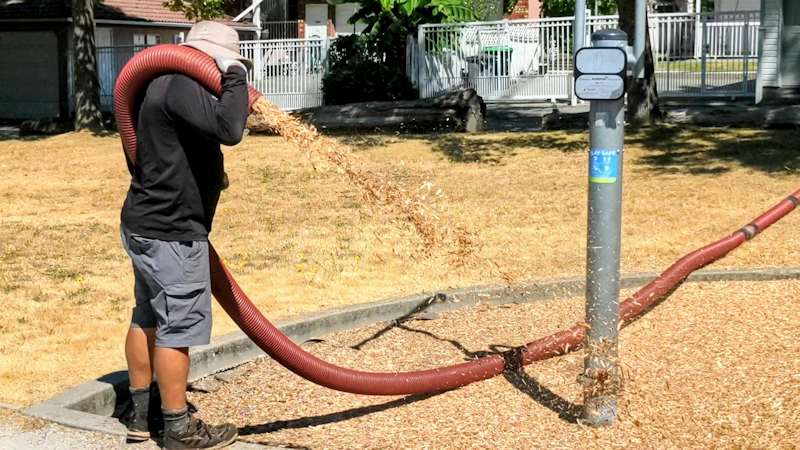
-
A clear, marked work zone established before the hose comes off the truck is the single most effective safety measure on a blower installation job.
-
Overhead lines, underground services, slope conditions and pedestrian routes should be identified during the walk-through, not discovered mid-install.
-
Eye, ear, and respiratory protection matter for everyone in the material path, including site staff who are not part of the blowing crew.
-
Hand signals and radio contact keep the nozzle operator and the truck operator aligned when engine noise makes normal conversation impossible.
-
Schools, parks, stratas and commercial properties each carry different access constraints that shape how the job is staged.
Installing bulk material with a blower truck moves hundreds of yards in a day, which is exactly why the work demands a disciplined approach to site safety. A Bark Blower propels bark mulch, playground woodchips, soil or sawdust through a long hose at speed, and the same force that places material neatly around planting beds and under play structures can create hazards if the work zone is not properly controlled. As a bulk supplier and blower truck installation service across the Lower Mainland and Fraser Valley, we plan every install around the conditions we find on site rather than around a fixed routine.
Job sites in progress add another layer. There may be landscaping crews nearby, students in a school, residents on a strata, or deliveries at a commercial site. It is more important to follow a sequence of actions when it comes to safety on these projects than any single rule.
Setting up a Controlled Work Zone
The site must be inspected before any hose can be pulled. We consider where the truck will park, the length of the hose, the surfaces that it will traverse, and whether or not other people are likely to move through the area at the time. Hose runs are designed to be long, as this allows for material to reach areas that would otherwise be difficult to reach with a wheelbarrow crew. The work zone can often extend beyond the truck.
The perimeter is marked with cones, tape, and signage, and the hose route is not treated as a path that people can cross. The parked truck can also be partially in a parking aisle or lane on municipal and commercial property. This requires traffic control that is appropriate for the road classification as well as the number of vehicles.
A few conditions consistently deserve attention during the walk-through:
-
Overhead power lines and low branches along the hose path or above the discharge area
-
Soft ground, wet turf or landscape fabric that may be disturbed by hose drag
-
Slopes, retaining walls and drop-offs where footing becomes unreliable
-
Storm drains, catch basins and irrigation heads that should stay clear of material
Where a site is tight or unusually complex, staging the work in sections is safer than trying to reach everything from one truck position. It takes slightly longer, and it keeps hose runs shorter and more manageable.
Crew Communication and Personal Protection
Blower units can be loud. Normal speech is not transmitted, so the truck driver and the nozzle operator must agree on a method of communication prior to the material moving. The radio is the default option, with a set of short hand signals to indicate stop, start and slow down the feed. Everyone on site should understand the stop signal, even the client's staff. This will allow anyone to stop the flow if they see a problem.
Anyone standing in the material flow or near the discharge point is required to wear personal protective equipment. Safety glasses protect against small bark pieces and fine particles that are travelling fast. For the duration of the operation, hearing protection should be worn around the blower. When working with sawdust, bark mulch, or aged material in still air, dust masks and respirators should be worn. Gloves, high-visibility clothing, and sturdy boots complete the standard kit. When we operate a Bark Blower on a property that is still open to the public, we also ask the site contact to keep foot traffic redirected until the section is finished and swept.
Discharge direction is a discipline of its own. The nozzle is never pointed toward people, windows, vehicles, or open building entrances, and the operator adjusts the angle and the distance so material lands rather than ricochets. Working with the wind rather than against it reduces airborne dust considerably and keeps the placement accurate, which matters when the goal is uniform depth across a bed or a play surface.
Site Conditions Across Different Property Types
We work primarily in schools and daycares. Installation of playground woodchips is typically scheduled during non-instructional hours or when the area is completely closed. A staff member will clear the space before the delivery truck arrives. The certified playground mulch must also be a consistent depth in order to function under the equipment. Therefore, the operator should work methodically and not quickly.
The public is always present, and it's impossible to close down the schedule. In these cases, the work can be divided into zones, so that one area is closed at a given time. The pathways are then reopened after each section has been cleaned and completed. In commercial and industrial settings, vehicle traffic, equipment movement, and loading docks are all factors to consider. This means you will need to coordinate with the site supervisor so blower work does not interfere with delivery times.
Nurseries, greenhouses and landscape depots often have narrow rows, irrigation systems and stock that needs protecting. Here the value of a blower truck is precise placement without heavy equipment tracking through growing areas, provided the hose route is planned to avoid crushing lines or disturbing product. Cleanup closes every job regardless of property type, since stray material on walkways, driveways and parking surfaces is both a slip risk and a drainage concern.
Site Safety Reference Table
|
Site Factor |
What We Assess |
Practical Step |
|
Truck positioning |
Access width, ground stability, lane obstruction |
Stage from a firm, level surface with signage or traffic control as required |
|
Hose path |
Distance, surface type, pedestrian crossings |
Mark the full run as part of the work zone and reroute foot traffic |
|
Overhead clearance |
Power lines, tree canopy, building overhangs |
Confirm clearance before positioning the nozzle or extending the hose |
|
Noise and dust |
Material dryness, wind direction, nearby occupants |
Radios and hand signals for the crew; eye, ear and respiratory protection in the material path |
|
Public access |
Students, residents, customers, site staff |
Section the work, barricade active areas, reopen after cleanup |
|
Site cleanup |
Stray material on hard surfaces and drainage points |
Sweep and clear before demobilizing from each zone |
Careful blower work protects people first, and it also protects the finished result. Uniform depth, clean edges and undisturbed surrounding surfaces are what a client is paying for when they choose installation over hand spreading, and those outcomes depend on an operator who is not rushing through a poorly controlled site. A Bark Blower used with proper staging, clear communication and appropriate protective equipment places material accurately with far less labour and far less disruption than crews with wheelbarrows moving across a property for days.
If you are planning a bulk mulch, soil or playground woodchips installation across the Lower Mainland or Fraser Valley, tell us about the site conditions when you book. Access constraints, occupancy schedules, slopes and overhead obstructions all shape how we stage the work, and knowing them in advance lets us bring the right setup on the first visit. Call 778-867-2275 for pricing, product details, or to schedule a bulk delivery or blower installation.
To enjoy these and many more benefits, contact our experts right away! We look forward to working with you on your next project!